Graduate Federal Aid Updates
This page summarizes recent federal financial aid updates and will be revised as additional guidance becomes available.
In July 2025, Congress enacted the Working Families Tax Cut Act (formerly known as the One Big Beautiful Bill Act), a major federal budget law that includes significant changes to the federal student loan and financial aid systems. Most of the provisions will take effect for loans disbursed on or after July 1, 2026, impacting students beginning in the 2026-27 award year.
Below are answers to some frequently asked questions about these changes and how they may affect your federal student loan eligibility.
-
Yes. Grad PLUS Loans are no longer available to new graduate and professional student borrowers for loans first disbursed on or after July 1, 2026. However, eligible legacy borrowers may continue borrowing Grad PLUS Loans under the Limited Exception.
-
The Limited Exception allows certain returning students to continue using the federal loan rules that were in place before July 1, 2026. Students who qualify are often called legacy borrowers.
To qualify, you must:
- Have been enrolled in your current program on June 30, 2026;
- Have received a Federal Direct Loan for that same program before July 1, 2026; and
- Remain continuously enrolled in the same program.
Eligible legacy borrowers may continue to borrow Grad PLUS Loans and remain subject to the prior loan limits until they reach their program’s expected time to credential.
-
Expected Time to Credential (ETC) is the amount of time you may remain eligible under the Limited Exception. It is based on the standard full-time length of your program.
Your ETC is the shorter of:
- Three academic years; or
- The time remaining in your program’s published length as of July 1, 2026.
For example, if you were one year into a two-year program on July 1, 2026, your ETC would be one academic year. Part-time enrollment, repeated courses, or other delays do not extend your ETC.
What happens when I reach my ETC?
Once you reach your ETC, you are no longer eligible to borrow a Federal Direct Graduate PLUS Loan for that program. You may still be eligible for Federal Direct Unsubsidized Loans, subject to federal annual and aggregate loan limits.
-
The Limited Exception applies only while you remain enrolled in the same program and have remaining expected time to credential. It may end if you:
- Withdraw from your program or from all coursework. Returning to Tufts later does not restore the exception.
- Complete or graduate from your program.
- Change to a new program. Examples include moving from a 4+1 bachelor’s program into the master’s portion, from a post-baccalaureate program to a master’s degree, or from a master’s program to a Ph.D. program.
- Reach your expected time to credential. Taking additional time because of part-time enrollment, repeated courses, or other delays does not extend this period.
Dropping one course or reducing your enrollment level does not, by itself, end the Limited Exception as long as you remain enrolled in your program.
-
Not necessarily. Having borrowed federal loans before your leave does not by itself establish legacy borrower status. To qualify for the Limited Exception, you must have been enrolled in the same program on June 30, 2026, received a Federal Direct Loan for that program before July 1, 2026, and return to the same program.
An approved leave of absence does not automatically make you ineligible, but eligibility must be reviewed based on your individual enrollment history. For help determining your eligibility, please contact gradfinaid@tufts.edu.
-
Beginning with the 2026–27 academic year, annual and aggregate Direct Unsubsidized Loan limits for graduate and professional students are changing:
Graduate programs: up to $20,500 per academic year, with a $100,000 aggregate limit.
Professional programs: up to $50,000 per academic year, with a $200,000 aggregate limit.
There is also a new $257,500 lifetime limit on federal student borrowing. This includes Direct Subsidized Loans, Direct Unsubsidized Loans, and Direct Grad PLUS Loans borrowed for undergraduate, graduate, and professional study. Federal student loans previously repaid, forgiven, canceled, or otherwise discharged still count toward this limit. Parent PLUS Loans are not included.
Once you reach the $257,500 lifetime limit, you will not be eligible for additional federal student loans.
-
Most Tufts master’s and doctoral programs are classified as graduate programs for federal loan purposes. Beginning July 1, 2026, the Entry-Level Occupational Therapy Doctorate (OTD) program is the only program on the Medford campus classified as a professional program and may be eligible for higher professional student loan limits.
This classification may change as the Department of Education issues additional guidance. We will update this page if there are changes.
-
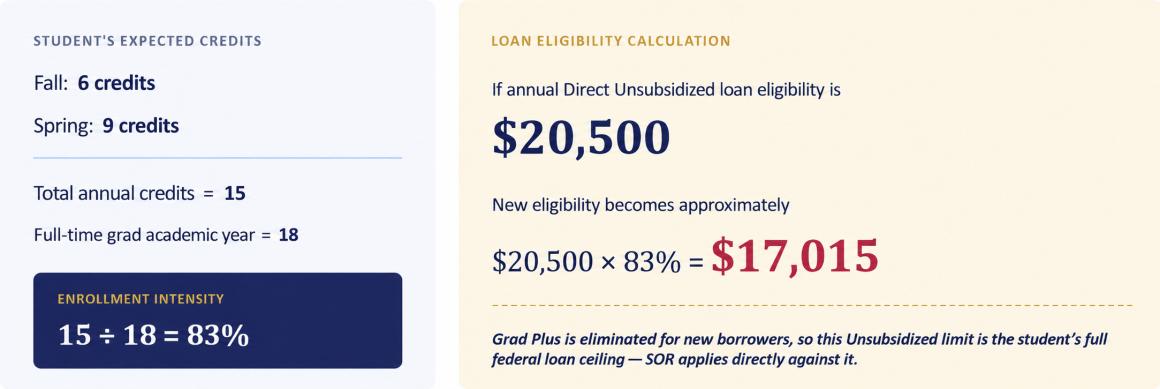
Beginning with the 2026–2027 academic year, federal Direct Loan eligibility will be reduced (prorated) for graduate and professional students who are enrolled less than full-time but more than half-time. This calculation is called the Schedule of Reductions (SOR).
At Tufts, full-time enrollment is:
- Per-credit programs in GSAS, the School of Engineering, and Fletcher GBA: 9 credits per term, or 18 credits per academic year.
- Flat-rate programs in the Fletcher School, Ph.D. programs, and Post-Baccalaureate Pre-Health and Studio Art programs: 12 credits per term, or 24 credits per academic year.
New federal regulations require colleges and universities to calculate loan eligibility based on a student's annual enrollment intensity.
Example: Student enrolled in 6 credits in the Fall and 9 credits in the Spring:
Rather than receiving the full $20,500 annual loan limit, the student's maximum Federal Direct Unsubsidized Loan eligibility for the year would be approximately $17,015 based on the student's enrollment intensity.
Graduate students considering dropping a course, withdrawing from a class, or enrolling less-than full-time should contact gradaid@tufts.edu before making any changes. Enrollment changes may reduce federal loan eligibility and could result in a balance due if loan funds have already been disbursed.
-
Yes. SOR rules apply to all federal student loans, including Grad PLUS Loans received by borrowers with legacy eligibility.
-
If you withdraw from a course after your loans have disbursed, we may need to recalculate your SOR based on your revised expected credits for the academic year.
If the withdrawal lowers your expected annual credits, your Direct Unsubsidized Loan eligibility may also be reduced. We would adjust any loan funds that have not yet disbursed first. If the amount already disbursed exceeds your revised eligibility, you may need to repay some funds or could have an outstanding balance.
-
If you need additional funding after using your available federal loans, you may consider a private educational loan. Private loans are credit-based, and eligibility, interest rates, and repayment terms vary by lender.
You may review options through Tufts’ preferred lender list or apply directly with the lender of your choice.
-
Please contact us at gradfinaid@tufts.edu. We will be happy to clarify these new regulations and how they may affect you.
Important Disclaimer: The content on this page is provided for informational purposes to assist Tufts students and families in understanding federal student aid programs and related changes. This information reflects our current interpretation of available federal guidance but does not represent official federal policy. Students and families should consult official U.S. Department of Education resources for authoritative information. Please visit StudentAid.gov for the most current guidance.
For additional resources published by Federal Student Aid (FSA) and national associations, please visit: